How to Improve Your Pickleball Serve
Share this on
If there’s one shot in pickleball that trips up beginners and intermediate players alike, it’s the serve. It seems simple on paper — underhand, below the waist, into the diagonal box — but between footwork, contact point, and consistency under pressure, a lot can go wrong. And unlike a rally shot where you get to react to what’s coming at you, the serve is entirely on you, which makes small technical flaws stand out fast.
The good news is that the serve is also one of the most trainable parts of the game. Small adjustments to grip, stance, and swing path tend to produce noticeable results quickly. Here’s how to actually improve it.
Understanding the Rules Before Fixing the Technique
Before working on form, it helps to make sure you’re not accidentally fighting the rules themselves.
- The paddle must contact the ball below waist level.
- The serve must be hit with an underhand motion — no overhead or sidearm serves.
- The paddle head must be below your wrist at contact.
- The serve must travel diagonally into the opponent’s service box, clearing the kitchen entirely.
A surprising number of “inconsistent” serves are actually the result of players unconsciously fighting these restrictions, especially those coming from a tennis background who instinctively want to swing overhand.
How to Improve Your Pickleball Serve: Start With Your Grip
Your grip has more influence on serve consistency than most beginners realize. A grip that’s too tight leads to a stiff, jerky swing, while a grip that’s too loose sacrifices control at contact.
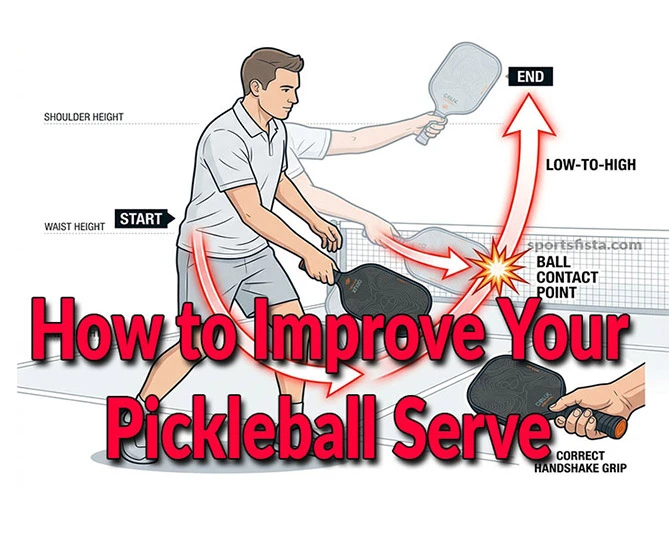
Most players do best with a continental-style grip — similar to a handshake grip — which allows for a natural, relaxed wrist during the swing. Holding the paddle too far forward in the palm (a “frying pan” grip) tends to limit wrist mobility and often leads to flatter, less controlled serves.
Fixing Your Stance and Setup
A consistent starting position does a lot of the work before you even swing.
- Stand with feet shoulder-width apart, body angled slightly toward the target box.
- Keep your weight balanced, not leaning too far forward or back.
- Toss or drop the ball to a consistent spot every time — inconsistent ball position is one of the most common causes of mishit serves.
- Keep your eyes on the ball through contact, not on the target.
Many players unconsciously change their toss or drop point serve to serve, which alone can throw off timing and contact more than any swing flaw.
Perfecting the Swing Path
The actual swing should be smooth and low-to-high, not a quick jab at the ball.
Focus on a pendulum-style motion, starting the paddle back and swinging forward in a controlled arc, contacting the ball below the waist and following through toward your target. Rushing the swing is one of the most common technical issues — a slower, more deliberate motion almost always produces more consistent results than trying to muscle the ball over the net.
Follow-through matters too. Stopping the swing right at contact tends to produce shorter, less controlled serves, while a full follow-through toward the target helps guide the ball’s direction more reliably.
Common Serve Mistakes to Fix
A few recurring issues show up across almost every skill level:
- Rushing the motion instead of using a smooth, controlled swing
- Inconsistent toss or drop point, throwing off timing
- Gripping the paddle too tightly, leading to a stiff, jerky motion
- Serving too flat, without enough arc to clear the net safely with margin
- Watching the target instead of the ball at the moment of contact
Most players are only dealing with one or two of these at a time — isolating which one applies to you speeds up improvement significantly.
Adding Spin and Placement
Once the basic mechanics feel solid, adding variety to your serve makes it much harder for opponents to anticipate.
- Topspin serves dip faster after crossing the net, making them harder to time.
- Slice serves curve slightly off the paddle face, pulling opponents wide of the box.
- Deep serves push the returner back near the baseline, limiting their ability to attack the return.
- Short, angled serves can pull an opponent off balance if placed well, though they carry more risk if mistimed.
Beginners shouldn’t worry about spin variation until the basic, consistent serve is reliable. Adding complexity too early usually just reintroduces inconsistency you were trying to fix in the first place.
Practice Drills That Actually Help
A few simple drills tend to produce faster improvement than just serving repeatedly without structure:
- Target practice: Place cones or markers in different areas of the service box and aim for them specifically, rather than just clearing the net.
- Consistency counting: Serve 20 in a row and count how many land in bounds, tracking improvement over multiple sessions.
- Slow-motion reps: Practice the swing at half speed to build muscle memory before adding full power.
- Deep serve focus: Dedicate a practice set specifically to serving as deep as possible without going out, since depth is often more valuable than raw power.
Consistency drills, done regularly, tend to produce faster and more lasting improvement than simply playing more casual games.
Mental Approach to Serving Under Pressure
Technique aside, the serve is also the one shot in the game where nerves show up the most, since there’s no rally momentum to rely on.
Developing a consistent pre-serve routine — the same number of ball bounces, the same breath, the same setup — helps create a sense of rhythm that holds up even in tight, pressure-filled moments. Players who rush their pre-serve routine under pressure tend to see their consistency drop noticeably compared to relaxed practice sessions.
Final Thoughts
Improving your pickleball serve comes down to a handful of controllable factors: a relaxed grip, a consistent toss or drop, a smooth low-to-high swing, and a steady pre-serve routine. None of these require athletic gifts — they just take repetition and a bit of attention to detail. Spend a few sessions focused purely on serve consistency rather than mixing it into full games, and the improvement tends to show up faster than expected.
Frequently Asked Questions
How can I make my pickleball serve more consistent?
Focusing on a repeatable toss or drop point, a relaxed grip, and a smooth low-to-high swing tends to produce the biggest improvement in serve consistency.
What is the best grip for a pickleball serve?
Most players find a continental-style grip, similar to a handshake grip, allows for better wrist mobility and control during the serve.
Why does my pickleball serve keep going into the net?
A serve that repeatedly hits the net is often caused by too flat a swing path or contact point that’s too low, so adding a bit more upward arc usually helps.
How do you add spin to a pickleball serve?
Topspin and slice serves are typically added by adjusting the paddle angle and swing path at contact, but these should only be layered in after the basic, flat serve is already consistent.
How many serves should a beginner practice per session?
Many players find that practicing sets of 20 serves and tracking how many land in bounds is a good way to build consistency without overtraining in a single session.