Pickleball Scoring System Explained
Share this on
Watch a pickleball match for the first time, and you’ll probably hear something that sounds like a phone number being shouted across the net — “3-2-1,” “5-4-2” — and wonder what any of it means. It’s the one part of the game that trips up almost every beginner, even ones who’ve already gotten comfortable with the paddle and the ball.
The good news is that once it clicks, it clicks for good. This guide breaks down exactly how scoring works, why it’s structured the way it is, and clears up the confusion around the newer rally scoring format that’s starting to show up in tournaments.
The Basics: Games Are Played to 11
Most recreational and tournament pickleball games are played to 11 points, and you need to win by at least 2. So a game could end 11-9, but if the score is tied 10-10, play continues until one side pulls ahead by two — 12-10, 13-11, and so on.
Some tournament formats use 15 or 21 points, especially for medal rounds, but 11 is the standard you’ll run into at most courts.
Only the Serving Team Can Score
This is the part that catches new players off guard the most. In traditional side-out scoring, points can only be won by the team that’s serving.
If the receiving team wins a rally, they don’t get a point — instead, they earn the right to serve. This is called a “side out.” So a game can go on for a while with the score barely moving if both teams are trading serves without ever actually winning a rally while serving.
This is very different from tennis or volleyball’s rally scoring, where every rally results in a point for someone, and it’s the single biggest mental adjustment for people coming from those sports.
How the Score Is Called Out
In singles, the score is simple: your score, then your opponent’s score.
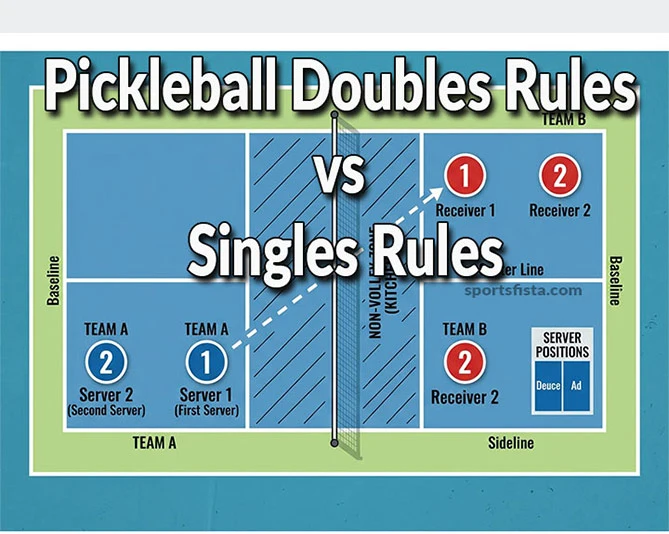
In doubles — which is how most pickleball is played — the score is called using three numbers:
- Your team’s score
- Your opponent’s team’s score
- Which server you are on your team (1 or 2)
So if you hear “6-4-2,” it means the serving team has 6 points, the receiving team has 4, and the person currently serving is the second server on their team.
Here’s why that third number matters: in doubles, each team typically gets two “chances” to serve before a side out, one for each player, except at the very start of the game.
The First Serve of the Game Is the Exception
At the beginning of every game, only one player serves before the first side out, instead of the usual two. This is often called the “start with 2” rule because the very first server on the very first team is treated as the second server, so the score starts at “0-0-2” instead of “0-0-1.”
It’s a small detail, but it’s one of the most commonly misunderstood parts of the scoring system, since it seems to break the pattern right out of the gate.
Walking Through a Full Sequence
It helps to see this play out step by step:
- The game starts at 0-0-2 (server 2, since it’s the first serve of the game).
- If the serving team wins the rally, the score becomes 1-0-2, and the same player serves again from the other side.
- If the serving team loses the rally, it’s a side out — the score becomes 0-0-1, and the ball goes to the other team to serve.
- Once a team has gone through both of its servers and lost a rally on both, the score fully passes to the other side, and their turn begins at (their score)-(opponent’s score)-1.
After a few rounds of this, the pattern becomes second nature. Most players stop consciously thinking about it within their first couple of matches.
Rally Scoring: The Newer Format
Some newer formats and certain tournament levels use rally scoring instead, where every single rally results in a point for someone, regardless of who served. This is closer to how volleyball scoring works today.
Rally scoring speeds up matches significantly, which is part of why it’s gaining traction in time-limited tournament settings. However, traditional side-out scoring is still what you’ll encounter at the vast majority of recreational courts and club play, so it’s worth learning that system first.
Common Scoring Mistakes Beginners Make
A few habits show up again and again with new players:
- Forgetting to call the score before serving (it’s required, not optional)
- Losing track of which server number they’re on in doubles
- Assuming a won rally always means a point, forgetting the side-out rule
- Mixing up singles scoring (two numbers) with doubles scoring (three numbers)
- Not realizing the game starts at “0-0-2” instead of “0-0-1”
None of these are serious problems — they just take a game or two of active practice to smooth out.
Final Thoughts
Pickleball scoring feels backwards at first because it rewards defense as much as offense — you have to actually win while serving to move the score forward. Once you’ve played a handful of games and called out a few scores yourself, the three-number system stops feeling like a puzzle and starts feeling automatic. Play a few matches, keep track of who’s serving, and it’ll click faster than you’d expect.
Frequently Asked Questions
How do you score in pickleball doubles?
Only the serving team can score points, and the score is called as three numbers: the serving team’s score, the receiving team’s score, and whether the current server is the first or second server on their team.
Why does the pickleball score start at 0-0-2?
At the very start of a game, only the first team’s second player serves before the first side out, since the very first server is treated as the “second server” — this is often referred to as the “start with 2” rule.
What is a side out in pickleball?
A side out happens when the serving team loses a rally, which means they lose their serve to the other team without either team scoring a point on that rally.
Do you score points in pickleball if you’re receiving?
No, in traditional side-out scoring only the serving team can score points; the receiving team can only earn the right to serve by winning a rally.
What is the difference between rally scoring and traditional scoring in pickleball?
Traditional side-out scoring only awards points to the serving team, while rally scoring awards a point on every single rally regardless of who served, similar to volleyball.