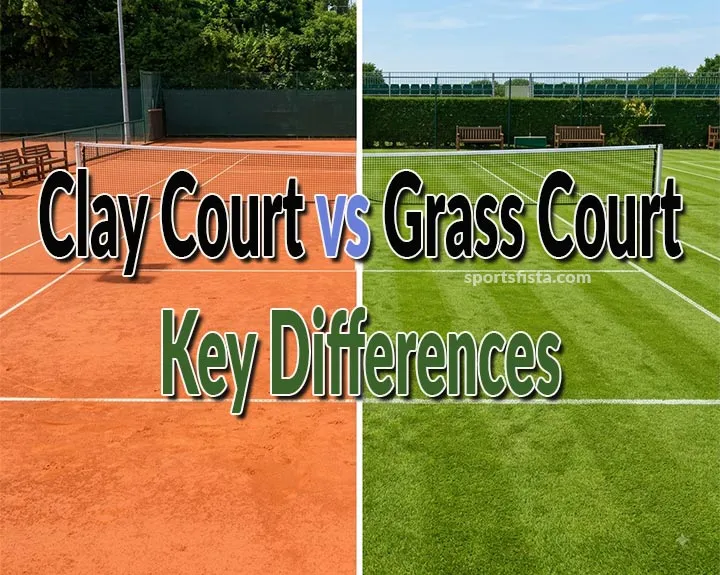
Clay Court vs Grass Court – Key Differences
Share this on
Ask any tennis fan which surface is their favorite, and you’ll probably start an argument. Clay and grass are about as different as two tennis surfaces can get, and that difference isn’t just cosmetic. It changes how the ball bounces, how fast points play out, and even which players tend to dominate on tour.
If you’ve ever wondered why Rafael Nadal built an empire at the French Open but never came close to that kind of dominance at Wimbledon, the surface is a big part of the answer. Let’s break down exactly what separates clay from grass, and why it matters so much to how the game is played.
What Clay Courts Are Actually Made Of
Despite the name, most clay courts aren’t pure clay. The top layer is usually crushed brick, shale, or stone, spread over a compacted base. That top layer is what gives clay its signature reddish-orange color at tournaments like the French Open, though green clay (often called “Har-Tru”) is also common, especially in the United States.
Clay courts need regular maintenance. Groundskeepers water them, brush them, and roll them to keep the surface even, and lines are often made of a different, more visible material embedded into the clay itself rather than painted on top.
What Grass Courts Are Actually Made Of
Grass courts are exactly what they sound like — real, living turf, grown and maintained like a very expensive lawn. Wimbledon, the most famous grass-court tournament in the world, uses 100% perennial ryegrass, chosen specifically because it holds up well under the pounding of professional matches while staying dense enough to produce a true, consistent bounce.
Grass courts are notoriously expensive and labor-intensive to maintain. They need to be mowed to an exact height, watered carefully, and given time to recover between matches, which is part of why grass-court tournaments are relatively rare on the professional calendar compared to clay and hard courts.
Ball Speed and Bounce: The Biggest Difference
This is where clay and grass really part ways.
On clay, the ball tends to bounce higher and slower. The gritty surface creates more friction, which grips the ball and takes some pace off it. That gives players extra time to reach shots, which is why you’ll often see long, grinding rallies during clay-court matches. A player who might be a step too slow to reach a ball on a faster surface often has just enough time on clay.
Grass does the opposite. The ball stays low and skids through quickly, since there’s very little friction between the ball and the smooth, slick blades of grass. Points on grass are typically shorter and more explosive, rewarding players who can finish rallies fast rather than grind them out.
How Playing Style Changes by Surface
Because of these bounce differences, certain playing styles thrive on one surface and struggle on the other.
Clay favors:
- Heavy topspin players who can generate high, bouncing shots
- Baseline grinders with strong stamina and footwork
- Defensive players who rely on extended rallies to wear opponents down
Grass favors:
- Big servers who can rack up easy points before a rally even develops
- Serve-and-volley players who rush the net while the ball is still low
- Players comfortable with quick reflexes and shorter points
This is exactly why a player like Nadal, whose heavy topspin and relentless baseline game are perfectly suited to clay, won the French Open a record-breaking number of times, while grass-court legends like Pete Sampras and Roger Federer built their reputations largely around big serves and net play.
Movement and Footwork
Sliding is a defining feature of clay-court tennis. Players slide into their shots, using the loose top layer to change direction and stop without jarring their joints the way a hard court would. It’s a skill in itself — players who grow up on clay often move more efficiently on the surface than those who didn’t.
Grass, on the other hand, doesn’t allow for sliding in the same way. Footing can actually be a little unpredictable, especially early in a tournament before the grass has worn down in high-traffic areas. Players need quick, small adjustment steps rather than long slides, and a slip on wet or fresh grass is a genuine risk.
Match Length and Physical Demands
Because of the slower bounce and longer rallies, clay-court matches tend to run longer and are widely considered more physically demanding over the course of a match. Points are earned through endurance and patience rather than one big shot.
Grass-court matches, by contrast, are often shorter and more service-dominated. It’s not unusual to see a set decided almost entirely by who’s serving well that day, since return games can be tough to win when the ball is skidding through low and fast.
Tournament Examples
- Clay: The French Open (Roland Garros) is the sport’s premier clay-court event, along with the Monte-Carlo Masters, Madrid Open, and Italian Open, all part of the “clay swing” leading up to Roland Garros.
- Grass: Wimbledon is the only Grand Slam played on grass, with smaller warm-up events like the Queen’s Club Championships and Halle Open held in the weeks beforehand to help players adjust.
Which Surface Is Harder to Play On?
There’s no single right answer, since it really depends on a player’s natural style. A big-serving player might find grass far easier to succeed on, while a grinder with heavy topspin might feel completely lost outside of clay. That said, most players and coaches agree that grass has the steepest learning curve, simply because there are so few grass courts available to practice on compared to clay and hard courts, and the season is short — usually just a few weeks a year.
Final Thoughts
Clay and grass sit at opposite ends of the tennis spectrum. One rewards patience, spin, and stamina; the other rewards speed, precision, and aggression at the net. Understanding this difference doesn’t just make watching tournaments like Roland Garros and Wimbledon more interesting — it also explains why certain players seem to dominate one event and disappear early at another. The surface isn’t just where the match is played. It shapes how the entire match is won.
Frequently Asked Questions
Why do clay courts make the ball bounce higher?
The gritty, granular texture of crushed brick or shale creates more friction with the ball, slowing it and pushing it upward for a higher bounce than on smoother surfaces.
Why is Wimbledon the only Grand Slam played on grass?
Grass courts are expensive and labor-intensive to maintain, and they wear down quickly under heavy match play. Wimbledon has kept its grass courts as a matter of tradition, since it’s the oldest tennis tournament in the world, but the other three Grand Slams shifted to clay and hard courts over time for practicality.
Is clay or grass easier on the body?
Clay is generally considered gentler on joints because of the sliding motion, which reduces the sudden stops and starts that cause strain on hard courts. Grass is also relatively soft, but the quick, jerky footwork it demands can increase the risk of slips and ankle injuries.
Why do some players struggle to transition from clay to grass?
The skills that make someone dominant on clay — long rallies, high topspin, sliding footwork — don’t translate well to grass, where points are faster, the ball stays low, and there’s very little time to set up a shot. It’s a completely different rhythm, and the short grass season doesn’t give players much time to adjust.
What surface does Wimbledon use, and why?
Wimbledon uses 100% perennial ryegrass, chosen for its durability and ability to maintain a dense, even surface throughout a two-week tournament despite heavy foot traffic.