What Is a Tiebreak in Tennis?
Share this on
If you’ve ever watched a set drag on and on, with both players holding serve game after game, you’ve probably wondered how it ever ends. That’s exactly what the tiebreak was designed to solve. Before it existed, sets could theoretically go on forever, and in a few rare, brutal cases, they actually did.
Once you understand how a tiebreak works, those tense, packed-stadium moments where a whole set comes down to a handful of points start to make a lot more sense. Here’s a full breakdown of what a tiebreak is, when it’s used, and why it’s become one of the most dramatic parts of modern tennis.
What Is a Tiebreak in Tennis, Exactly?
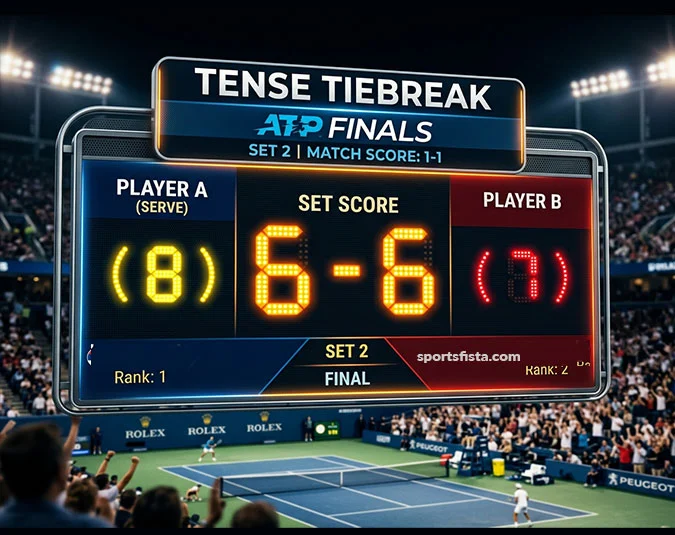
A tiebreak is a special mini-game used to decide a set once the score reaches 6-6 in games. Instead of continuing to play full games until someone leads by two, players switch to a shorter, faster format where the first player to reach 7 points, with at least a two-point lead, wins the set.
So instead of a set score like 9-7, which would take a long time to reach under the old rules, you’ll see a set decided as 7-6, with the tiebreak score often written in parentheses, like 7-6(4), showing the final tiebreak points.
How Tiebreak Scoring Works
Tiebreak points are counted differently from regular game scoring. Instead of the familiar 15-30-40 system, tiebreak points are counted simply — 1, 2, 3, and so on — which is one of the small quirks that catches beginners off guard.
Here’s the basic structure:
- Players alternate serving throughout the tiebreak, but not evenly like a regular game.
- The player whose turn it was to serve starts the tiebreak by serving one point.
- After that first point, players switch off serving two points at a time for the rest of the tiebreak.
- The first player to reach 7 points, leading by at least 2, wins the tiebreak and the set.
- If the score reaches 6-6 within the tiebreak, play continues until one player finally gets that two-point cushion — 8-6, 10-8, 12-10, and so on.
Players also switch sides of the court every six points during a tiebreak, which helps keep conditions like sun and wind fair for both players during longer tiebreaks.
Why Tiebreaks Were Introduced
Before tiebreaks became standard, sets had no cap — players simply kept playing until someone won by two games, no matter how long that took. This occasionally led to marathon sets that stretched on for hours, exhausting players and throwing off tournament schedules.
The most extreme example happened at Wimbledon in 2010, when John Isner and Nicolas Mahut played a final set that lasted 11 hours and 5 minutes over three days, ending 70-68, since Wimbledon didn’t use a final-set tiebreak at the time. That match became such a famous outlier that it directly influenced later rule changes across the sport.
Tiebreaks were introduced to prevent situations like this from becoming common, keeping matches more predictable in length while still preserving the tension of a close set.
Are Tiebreaks Used in Every Set?
Not always, and this is where things get a little more complicated. Tiebreaks are standard in every set except, historically, the final set of certain tournaments — though this has changed significantly in recent years.
- Grand Slams: All four majors now use some form of final-set tiebreak, though the format varies. Wimbledon and the French Open use a tiebreak at 6-6 in the final set. The US Open has always used a standard tiebreak at 6-6. The Australian Open uses a longer, first-to-10 tiebreak in the final set instead of the usual first-to-7.
- Regular tour events: Nearly all ATP and WTA tournaments use standard tiebreaks in every set, including the final one, to keep match lengths manageable across a long season.
This shift toward final-set tiebreaks across all four majors is relatively recent, largely a direct response to marathon matches like Isner–Mahut putting pressure on tournament scheduling and player safety.
Why Tiebreaks Feel So Different to Play and Watch
Tiebreaks tend to feel more intense than regular games, and there’s a real reason for that beyond just the stakes. Because the format is so short, a single mistake or a single great shot can swing momentum immediately. There’s very little room to recover from a slow start the way there is across a full six-game set.
This is part of why some players are known specifically for being strong “tiebreak players.” Big servers tend to have an advantage, since a few well-placed serves can quickly build a lead in a format where every point carries extra weight. Mental composure also matters enormously — players who stay calm under pressure often outperform their overall stats specifically in tiebreak situations.
A Simple Tiebreak Example
Imagine a set reaches 6-6. Player A served the last game, so Player A serves the first point of the tiebreak. From there, Player B serves the next two points, then Player A serves two, and so on, alternating in pairs. The score climbs — 3-2, 4-3, 5-4 — until Player A reaches 7 points while Player B is stuck at 5. Since that’s a two-point lead, Player A wins the tiebreak, and the set is recorded as 7-6.
Final Thoughts
A tiebreak in tennis exists to bring closure to sets that would otherwise have no natural end point, turning a potentially endless string of games into a short, high-pressure sprint to the finish. It’s become one of the most exciting parts of modern tennis, often producing some of the tensest, most memorable moments in a match. Once you understand the serving pattern and the two-point-lead rule, following along during a tiebreak becomes second nature — and honestly, a lot more fun to watch.
Frequently Asked Questions
How many points do you need to win a tiebreak in tennis?
You need to reach 7 points with at least a two-point lead. If the score reaches 6-6 within the tiebreak, play continues until one player finally gets a two-point advantage.
How is serving handled during a tennis tiebreak?
The player who was next to serve starts the tiebreak by serving one point. After that, players alternate serving two points at a time for the rest of the tiebreak.
Do all Grand Slams use a final-set tiebreak?
Yes, as of recent rule changes, all four Grand Slams now use some form of tiebreak in the final set, though the Australian Open uses a longer first-to-10 format instead of the standard first-to-7.
What is the longest tennis match ever played because there was no final-set tiebreak?
The 2010 Wimbledon match between John Isner and Nicolas Mahut lasted 11 hours and 5 minutes across three days, ending 70-68 in the final set, since Wimbledon didn’t use a final-set tiebreak at the time.
Why do players switch sides during a tiebreak?
Players switch sides every six points during a tiebreak to keep conditions like sun, wind, and court lighting fair for both players, especially important if the tiebreak runs long.